Simple Activity Logging with Default Values
Feature Detail
Description
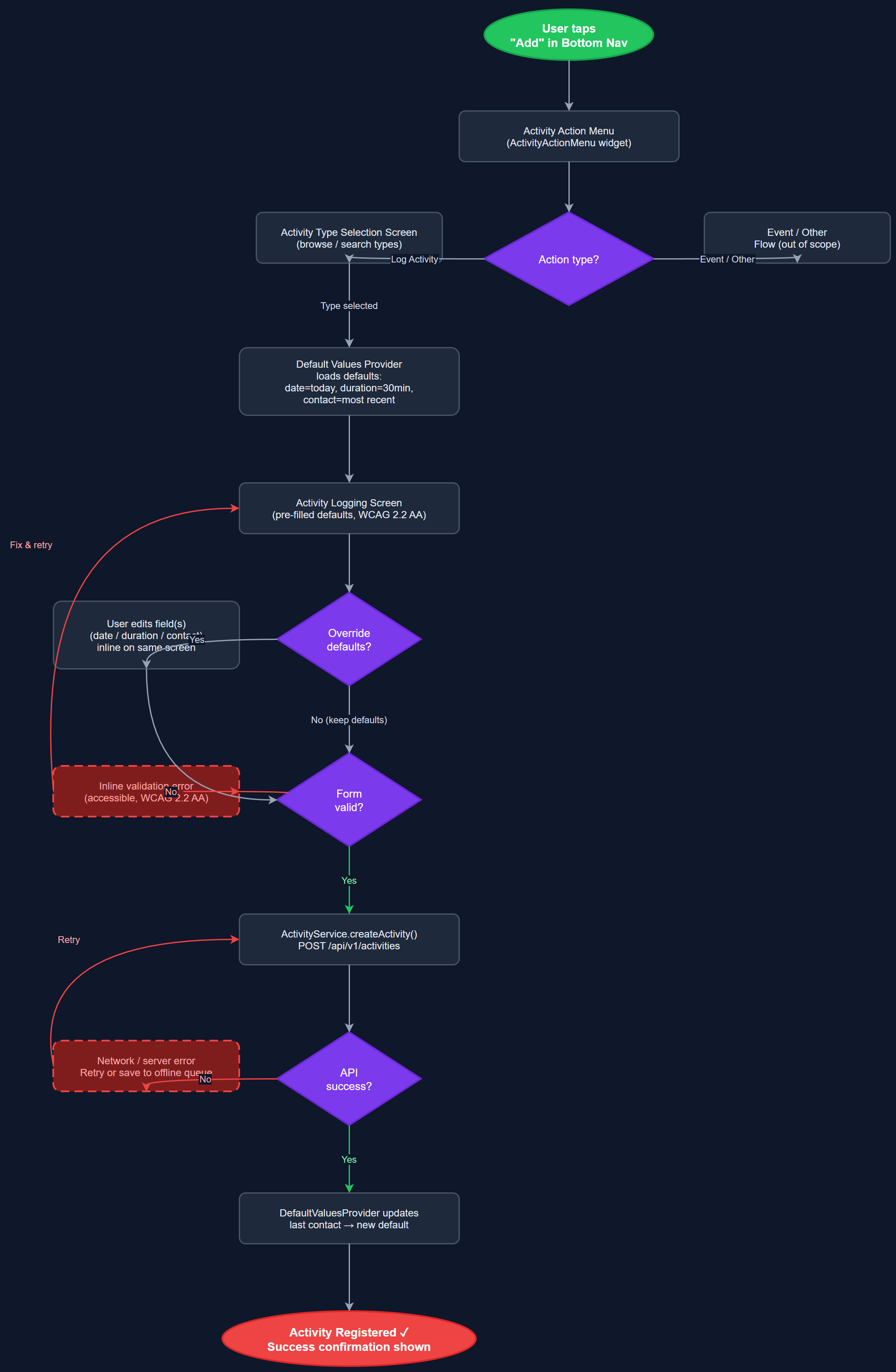
Core activity logging with pre-filled default values (today's date, 30-minute duration, most recent contact). Designed for minimum cognitive load — peer mentors can complete a registration in under two taps for routine activities. Supports the 60-70% of all registrations requiring no reimbursement, making the most common workflow frictionless. Fully WCAG 2.2 AA compliant with accessible touch targets and screen reader support on both iOS and Android.
User Flow
Analysis
Activity registration is the #1 priority across all three workshop organizations. Today, peer mentors submit paper or Word-based forms aggregated manually in Excel, leading to massive underreporting — not from lack of intent, but from friction. A one-to-two tap flow with intelligent defaults transforms compliance from a burden into a reflex, significantly increasing data coverage and quality. For Bufdir reporting and reimbursement workflows, accurate activity data is the foundation of every downstream output. This feature directly determines whether the application delivers its primary value proposition, making it the highest-leverage investment in the entire product.
Built in Flutter with BLoC state management. The DefaultValuesProvider injects today's date, a configurable default duration (30 min), and the most recently used contact, fetched from local cache. Activity types are loaded from the REST API and persisted via SQLite for offline availability. Submission is optimistic — the activity is saved to a local sync queue immediately and replicated to PostgreSQL asynchronously via SyncService. WCAG 2.2 AA requires 44×44px minimum touch targets, visible focus rings, and semantic Semantics() labels on all interactive elements for VoiceOver and TalkBack compatibility. All user-facing strings must support the organization labels system for dynamic terminology.
Definition of Done
Components (64)
Shared Components
These components are reused across multiple features
User Interface (16)
Service Layer (13)
Data Layer (9)
Infrastructure (20)
User Stories
No user stories have been generated for this feature yet.