Encrypted Assignment Dispatch & Tracking
Feature Detail
Description
This feature enables coordinators to securely dispatch sensitive assignment information — including personal details such as name, address, and medical summaries — to peer mentors via end-to-end encrypted messaging. The system tracks assignment status through the full lifecycle from dispatch to completion, providing read and delivery confirmations. It consolidates encrypted assignment dispatch, assignment status tracking, and sensitive data messaging into a single cohesive workflow that meets Norwegian data protection requirements.
User Flow
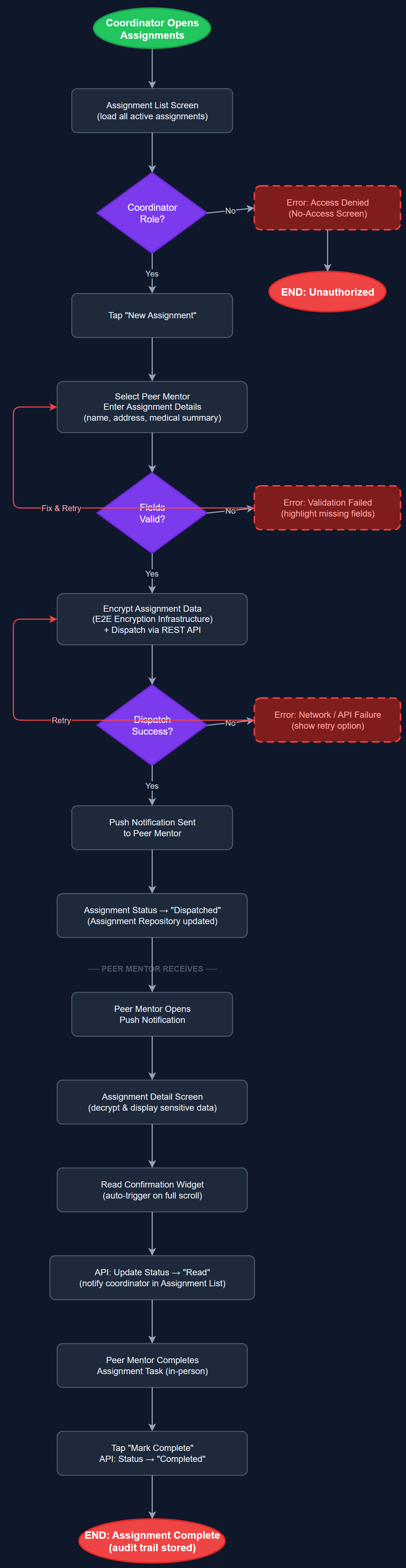
Analysis
Blindeforbundet requires the ability to transmit sensitive personal data — including epikrise excerpts and home addresses — to peer mentors for home visit preparation. Doing this via email or phone is insecure and non-compliant with GDPR. End-to-end encrypted dispatch with delivery and read confirmation ensures accountability, auditability, and legal compliance. Coordinators gain real-time visibility into which assignments have been received and acknowledged, eliminating manual follow-up calls and reducing the risk that peer mentors begin visits without fully reading the assignment brief. This is a hard blocker for Blindeforbundet adoption.
End-to-end encryption must be implemented using a proven asymmetric key exchange protocol (e.g., X25519 + AES-GCM) with per-user key pairs stored in secure device storage. The Flutter client encrypts messages locally before transmission; the backend stores only ciphertext and metadata. Push notification infrastructure delivers assignment alerts without exposing content in the notification payload. The assignment_status_logs table tracks state transitions (dispatched → delivered → read → acknowledged). Read confirmation is implemented via a mandatory in-app acknowledgement action, not passive read receipt, ensuring the peer mentor has consciously reviewed the assignment before the coordinator is notified.
Dependencies
Definition of Done
Components (65)
Shared Components
These components are reused across multiple features
User Interface (16)
Service Layer (13)
Data Layer (9)
Infrastructure (20)
User Stories
No user stories have been generated for this feature yet.